
The Story Behind The Nicholson Gallery
Written and edited by Shayla Torres
The Nicholson Gallery
Tucked along the storied stretch of Miami Circle, Nicholson Gallery is more than a showroom of antique and vintage interiors. It is a passage into a world where a curated love story finds its new home, continuing a lineage still unfolding. It is a place where time softens, where patina bears the etchings of centuries past, and where objects are chosen not for display, but for dialogue.
At the heart of this world is Martha Nicholson. With a discerning eye shaped by decades of devotion to interiors and antiques, she has cultivated a space that feels less like a gallery and more like an intimate exchange between history and modern life. Her story begins long before the gallery opened its doors. Antiques were part of her upbringing, passed down from both sides of her family. From an early age, she learned not only to admire, but to understand. Her mother ensured she knew the style, origin, and age of every piece. By eighteen, she had saved her earnings not for frivolities, but for her first acquisition, a linen press.
“My mother made sure I learned the style, origin, and age,” she says. “She knew I was passionate about this kind of thing.”

What Martha calls home is never static. It listens. It softens. It gathers the seasons the way fabric gathers scent. Her late 1930s cottage sits quietly beneath a canopy of trees, its painted brick worn to a shade she affectionately calls “dirty white.” Fig vines climb its surface, less ornamental than companion, returning each year with patient certainty. Nothing here asks for perfection. It asks to be lived with.
“I often say I’ve simply put lipstick on a pig,” she laughs, “but I have loved her from the minute I saw her.”


Most mornings begin on the porch, yogurt and berries in hand, as she watches the light shift along the hedges. The house reveals itself slowly, she says. If she is quiet enough, it always shows her something new. This threshold between inside and out is where she moves between worlds. The stillness of home and the rhythm of the gallery.

Inside, the light behaves differently. It softens edges and quiets the room. The dining space becomes its own observatory, glowing early in the day and settling gently as the hours pass. Martha stands at the table, focused and unhurried, finishing a cake she baked earlier that morning. Decorating it is a familiar pleasure, one she returns to often.
Baking is her favorite ritual in the kitchen. Pound cakes, whiskey cakes, meringues, cookies. When it comes time to finish them, she steps outside, clipping a few stems from a nearby bush, placing them loosely around the cake alongside whole oranges. The result is imperfect and intuitive, guided more by instinct than design. Simple, a little unruly, quietly charming.
The table holds the evidence of use rather than display. Glassware catches the light unevenly. A few objects remain from breakfast. Others have wandered in as the morning unfolds. Mirrors along the walls gather fragments of light, reflecting the scene back in softened layers. Greenery rises near the open doors, blurring the boundary between indoors and out.
This is not a room prepared for company. It is a room in use, shaped by habit, instinct, and the pleasure of living among beautiful things.
Decorating, for Martha, is never about occasion. It is about living.
“I use everything I have,” she says. “I don’t wait.”

The mirror wall is her constellation. Collected over decades, no two frames match. Some are bright, others muted by time. Many are softened by the silvered haze of mercury glass she loves so deeply.
“I love mirrors. Lots of them. Only with mercury glass,” she says. “They are dark, so reflective but never bright. They inspire me. Oh, if they could talk.”
Before the gallery, there were years spent shaping interiors. Those years taught her how rooms hold emotion, how scale matters, how restraint can be as powerful as abundance. That instinct still guides the gallery today, not as a formula, but as a feeling.


Moving through the house feels like a gentle unfolding. You begin in the dining room, where light and ritual take shape, then drift into the living space, where the mantel comes into view and objects gather with quiet intention.
The mantel carries its own quiet authority. It is not styled to impress, but to hold. A portrait of her great-great-grandfather rests above it, dating back to the 1800s, presiding gently over the room. Below, small objects gather without hierarchy. Carved figures, vessels, fragments of color, moments of humor. Nothing is precious. Everything belongs.
“I don’t think of it as decorating,” Martha says. “It’s more like keeping company. You notice when something wants to move.”


Beyond the mantel, a guest room opens into a more intimate part of the home. The walls here are lined with portraits of those who came before her. Generations of family members, some captured in early photography, others rendered in paint, observe quietly. They are not displayed as relics, but held as presence. Reminders that taste, curiosity, and instinct often echo through bloodlines, carried forward without instruction.

In one corner hangs a painted portrait of Martha as a younger woman, half-hidden, more personal than performative. She finds it a little embarrassing, she admits, yet it remains. Past and present regard one another calmly here. The house makes room for both without contradiction.


The bedroom offers one of the most beautiful vantage points in the home. Steel framed windows stretch outward, drawing the eye back to the garden. Mornings often begin here, with fruit or coffee carried to the small table beyond the glass. Leaves rustle. Birds pass through. Light bends across the surface in patterns that change with the hour.
Sometimes she sits and watches. Sometimes she listens. The ritual is brief, unremarkable, grounding.
The house exhales, and so does she.

The gallery is not a departure from her home, but an expansion of its philosophy. What begins with Martha’s eye for sourcing, history, and provenance is carried forward into a space shaped through collaboration, interpretation, and care. The scale widens. The rooms breathe differently. Objects are no longer gathered for personal use, but placed so others might imagine living alongside them.
Each piece arrives with a life already lived, sourced through long standing relationships across Europe. Once here, the gallery takes form slowly. Furniture, pottery, mirrors, and paintings are arranged through a shared understanding of balance, restraint, and atmosphere. The result is not a fixed composition, but an evolving one, guided by instinct, dialogue, and time.
The space resists spectacle. It favors proportion over excess, mood over perfection. Light is allowed to fall unevenly. Objects are given room to speak. What emerges is a visual language rooted in Martha’s philosophy, translated into form through thoughtful styling and constant attention.
Nothing here is meant to overwhelm. Everything is meant to endure.


What matters most to Martha is how people feel when they enter and how that feeling follows them home. She wants the space to register not as a showroom, but as a place already in use, familiar, lived in, open to imagination.
“I want people to feel like they’ve walked into a moment,” she says. “Not something staged, but something already happening.”
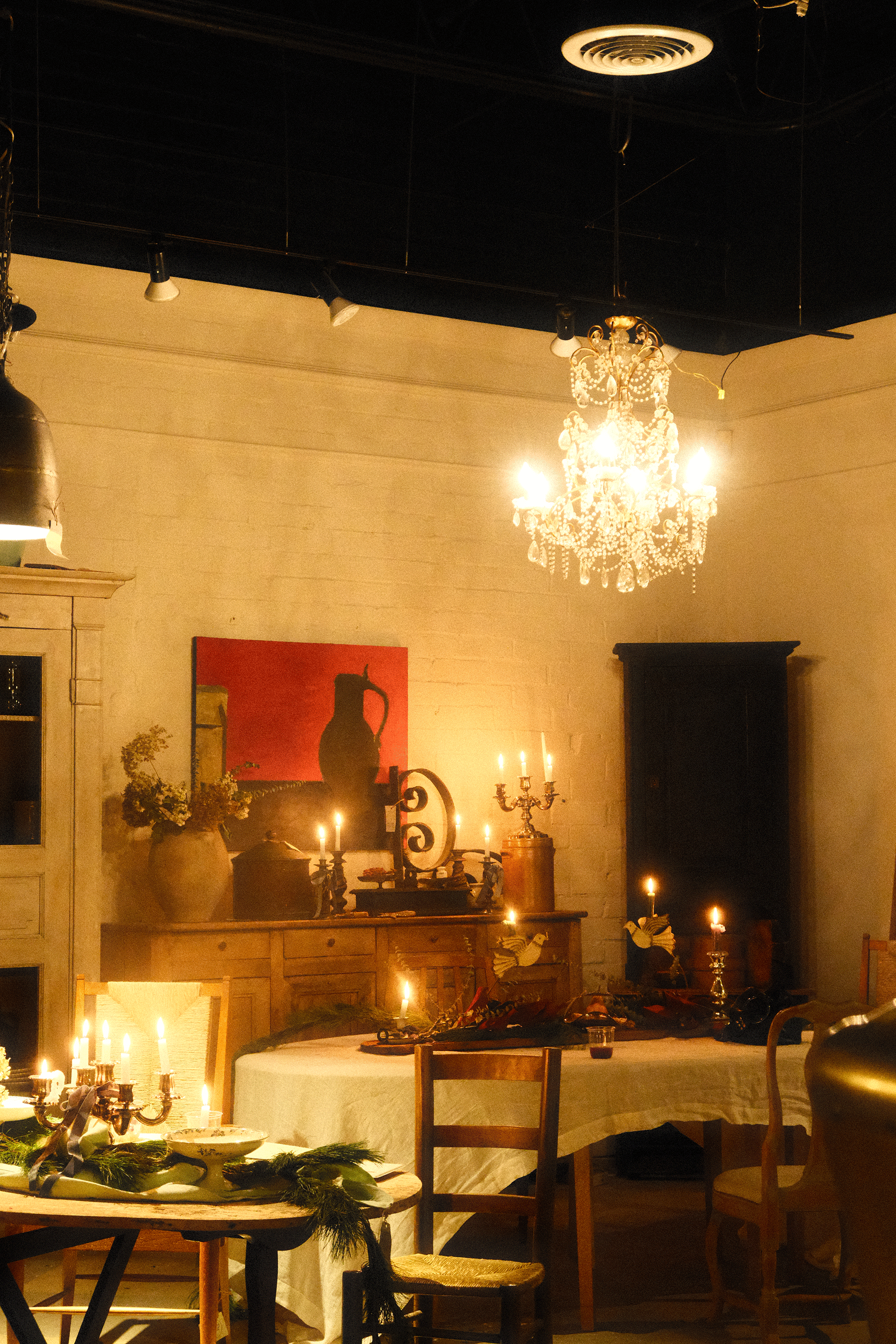
In the vignettes throughout the gallery, a Provençal table might appear as if lifted from a countryside feast mid pause. Linen falls loosely. Terracotta and ceramic vessels rest against timeworn books. Lemons spill. Petite Anduze pots add weight and color. A dried dogwood branch rises from a glass vase, sculptural and steady, a quiet mascot for the space.


From one angle, the gallery feels like a dining room that never stops evolving. Turn another corner and it becomes the Nicholson Café, with a bar and bistro tables scattered with unmatched French seating options. Elsewhere, it settles into a study in restraint, the discipline of leaving space around something beautiful, the confidence to let a single vessel carry a surface.
This is the part most people do not see. It is revised. It is considered. It is lived with until it clicks.
“It’s never finished,” Martha says. “The moment a large piece leaves, everything changes. We have to reconsider the room, find a new balance, let a different story come forward. That's the fun part.”


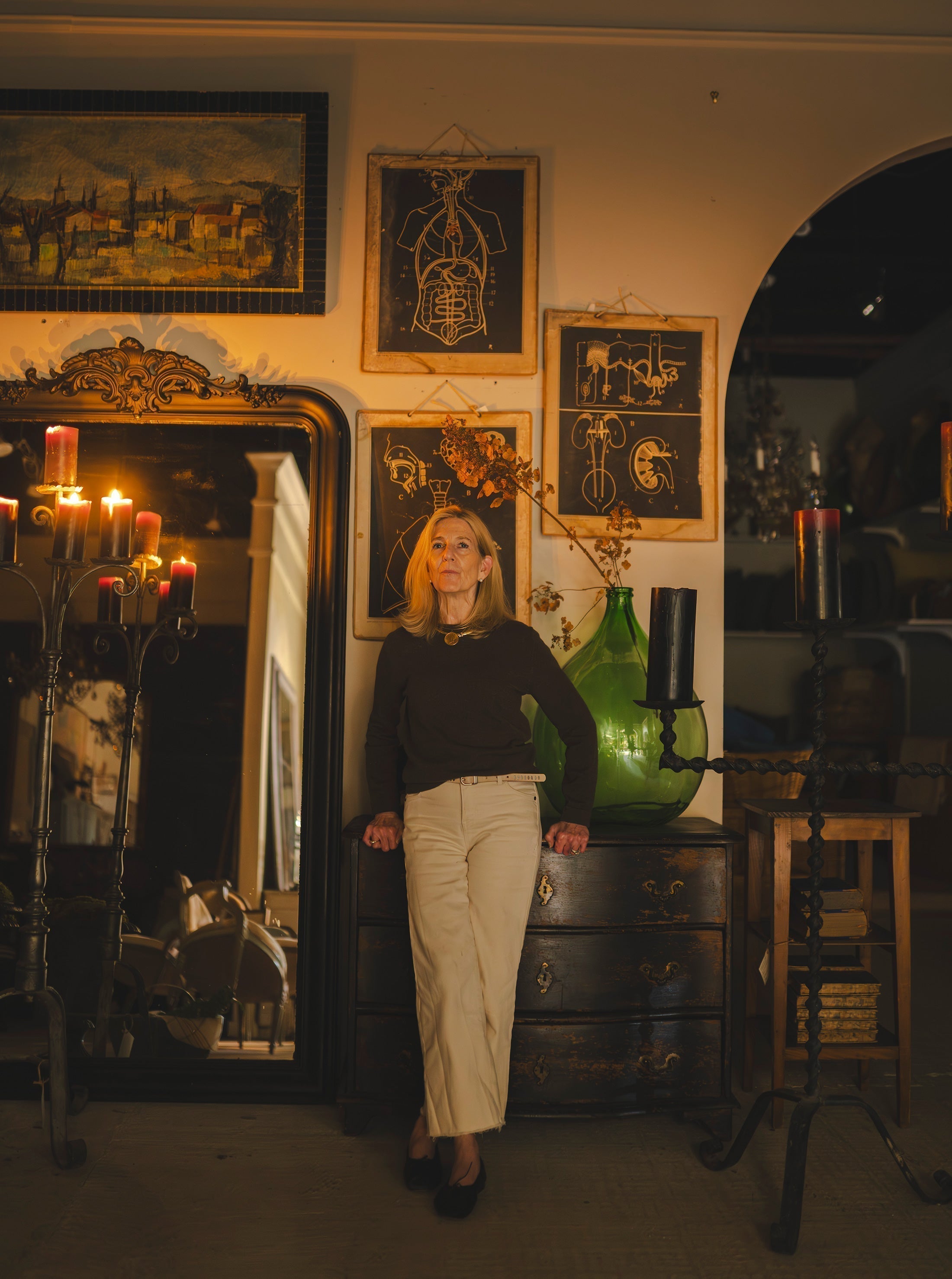
Where the gallery opens and shifts with movement, there are also moments of pause. Martha appears in the space not as a presenter, but as a presence. Seated, standing, absorbed, she becomes part of the composition rather than its focal point.
“I like when the room does some of the talking,” she says. “You don’t need to explain everything if the feeling is right.”


What anchors the gallery is not only how objects are arranged, but how they are chosen. Martha’s relationship to French antiques was built slowly, through return, trust, and familiarity. Many pieces never passed through open markets. They were kept within families, or held by vendors whose parents and grandparents knew their histories.
“I’m always looking for things that show how they were used,” she says. “Pieces that have lived.”
Her eye favors provincial furniture and everyday objects made for function before ornament. Objects that carry weight, proportion, and age without needing explanation.

In the end, the gallery reflects what has always mattered most to her. Not perfection or novelty, but presence.
Objects are chosen for their quiet authority. For the way they hold a room without asking for attention. For how easily they slip into someone else’s life and begin again.
The Nicholson Gallery is not about collecting more.
It is about living better with what endures.
And like the space itself, the story is never finished.