

Article: Going to Hell in a Handbasket?
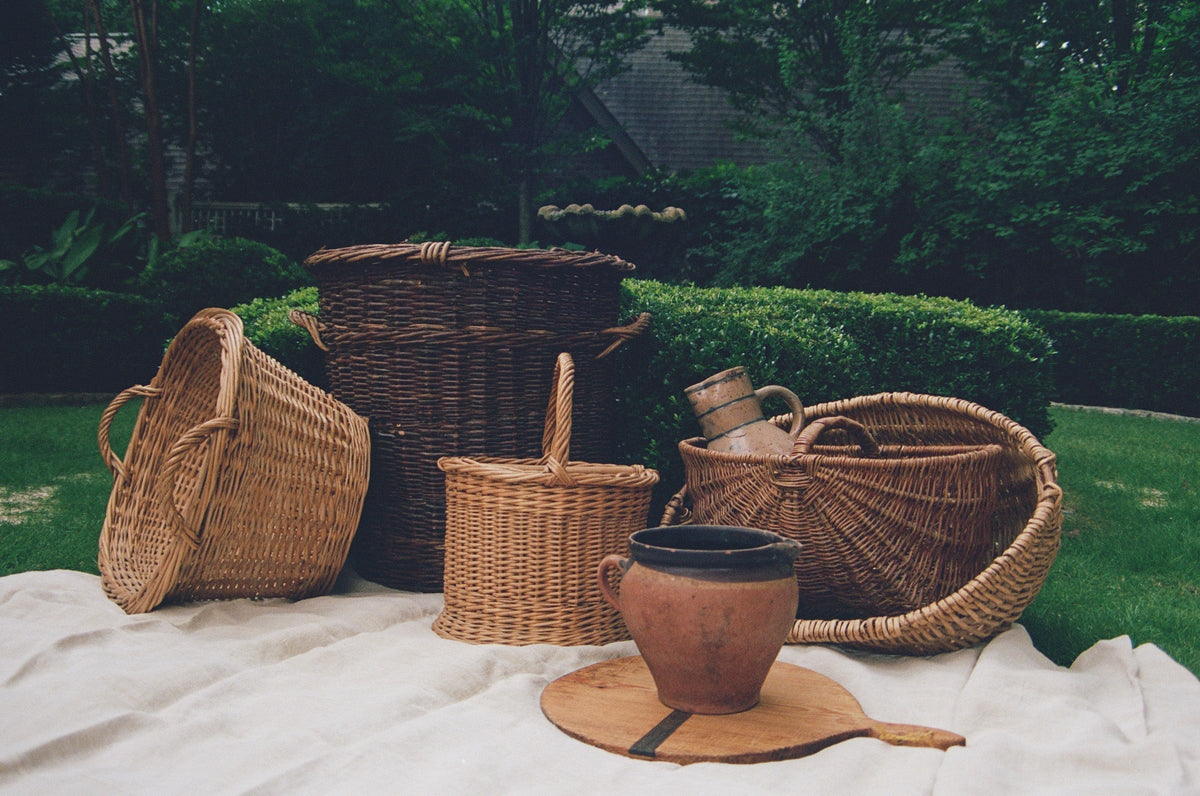
Going to Hell in a Handbasket?
Why Every Technological Revolution Sends Us Looking for Handmade Things

Written by J.T.J.T Davis
Edited by Shayla Torres
This morning, two designers from the Georgia coast made a stop at The Nicholson Gallery.
They wandered through room after room filled with French armoires, English tables, painted cupboards, and stone garden ornaments before arriving in our basket room, where they lingered the longest.
As they admired nineteenth-century gathering baskets, I noticed something that made me smile.
Each woman carried a designer wicker handbag. The bags matched the energy of their owners: polished, witty, and just unexpected enough to feel entirely personal.
Basket enthusiasts in every sense of the word,

here were two women who had traveled across the state in search of antique baskets while carrying modern counterparts over their shoulders. The forms had changed. The scale had changed. One was destined for a mudroom or pantry, the other for an afternoon in town. Yet the material, the texture, and perhaps even the instinct behind them felt remarkably familiar.
It struck me that this was no coincidence.
The expression "going to hell in a handbasket" has been around for centuries. Its origins remain uncertain, but the feeling behind it is instantly recognizable: the world is changing too quickly.
Curiously, whenever that feeling takes hold, we seem to reach for things made slowly.
That question had been on my mind since June, when I visited Shelburne Museum in Vermont. Moving through its collections, I found myself thinking about the person who had recognized the value of these ordinary objects long before most museums considered them worthy of preservation.

That person was Electra Havemeyer Webb.
She had every reason to become another grande dame of American art collecting. Born into one of America's great collecting families, she grew up surrounded by Monets, Degas, and Manets. Instead, she developed a habit that must have puzzled her fellow antique enthusiasts.

While everyone else was chasing masterpieces, Electra was buying chicken coops, weathered baskets, trade signs, hooked rugs, decoys, carousel animals, worn farm tools, and just about anything that was emblematic of rural life. If an object had been handled, repaired, and quietly depended upon for generations, she wanted it. At one point, she even had the 220-foot steamboat, the Ticonderoga, hauled more than two miles overland, across fields and through a swamp, to its permanent home at the Shelburne Museum.

As collectors competed for paintings with impeccable provenance, Electra was rescuing objects many people considered too ordinary to deserve saving. Time has been remarkably kind to her judgment.
In 1947, she transformed that obsession into Shelburne Museum, proving that a gathering basket deserved to be looked at with the same care as an oil painting.

During my visit, it was the baskets that stayed with me.
At first they seemed almost interchangeable. Row after row of woven forms, familiar handles, familiar materials. But the longer I looked, the less alike they became.
One leaned ever so slightly. Another had been repaired decades earlier with whatever material happened to be nearby. One had darkened where thousands of hands had lifted it. Another still carried the faint irregularities of the person who first wove it.
Suddenly they felt less like objects and more like biographies.
Perhaps that was what Electra understood before almost anyone else. These baskets were never simply containers. They were records of ordinary lives, preserved one careful decision at a time.


Today we find ourselves in another extraordinary technological moment. Artificial intelligence can compose music, generate images, write essays, and design rooms in seconds.
Curiously, our appetite for handmade things has only grown stronger.
We want linen that softens with washing, pottery that varies slightly, wood that records the touch of a hand, mirrors that remember faces gone by, and baskets whose woven surfaces still reveal the decisions of the person who made them.
Technology gives us speed. Handmade objects give us something else entirely.
Every technological revolution seems to convince us that we're going to hell in a handbasket.

Oddly enough, it also sends us looking for one.
As I watched the two designers leave the gallery that morning, woven handbags over their shoulders after spending an hour with baskets nearly two centuries older, it occurred to me that very little had changed after all.

The basket has carried food, flowers, firewood, and laundry. Now it may carry a phone and a set of keys.

Its purpose evolves.
Our fascination with it does not.
Perhaps that is the comfort of a basket.
It does not buzz, update, or ask for our attention. Its structure is visible. Its purpose is honest. It simply waits to be useful.

In a world that often feels abstract and accelerated, there is reassurance in something built patiently, one woven strand at a time.
Artificial intelligence may very well change the way we write, work, design, and communicate.
I would still like to see it weave a basket.


