

Casting Shadows: On Silence, Stillness, and the Philosophy of Interior Space
Written and edited by: Shayla Torres.
There is a particular moment that happens at home when the lights are off and the room is not entirely dark, when a distant streetlamp or a passing car touches an object for only a few seconds and then disappears again, leaving behind the memory of a silhouette rather than the certainty of form. Most people move through this without noticing it, but when you begin to sit still long enough, when you allow yourself to exist in that suspended space between waking and dreaming, you realize that interiors are not only defined by what we see clearly, but by what remains partially hidden, partially felt, and deeply atmospheric.
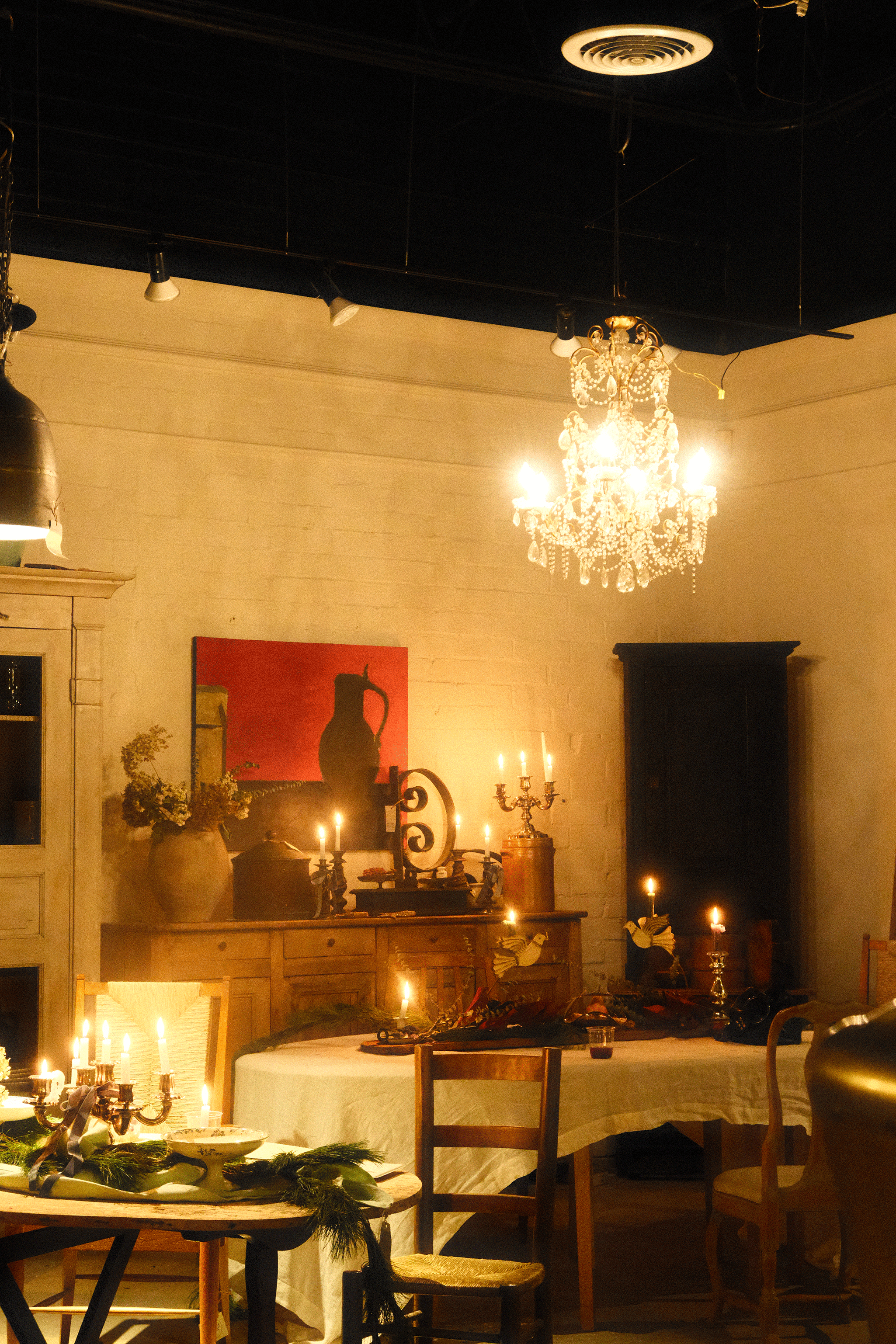
This series began from that observation. Not from a desire to decorate, but from a desire to understand what happens when objects are arranged as if the room itself were meditating. At the gallery, I approached the styling almost as if my eyes were closed, placing clay against wood, vessels beside chairs, and silhouettes within reach of each other without relying on the traditional logic of where furniture “belongs.” Instead, I worked from intuition, guided by the way shadow moves across form and how certain shapes continue to exist even when they are barely illuminated.

The ladderback chair became the first quiet anchor, not because of its function, but because of how light traced the woven seat and transformed it into a grid of shadow across the floor. French provincial furniture has always carried this understated presence, shaped less by spectacle and more by proportion, and when viewed through dim light, the chair ceases to feel like an object of use and instead becomes a structure that holds time. Philosophers like Gaston Bachelard wrote about the house as a psychological space, suggesting that certain corners invite reverie simply through their stillness, and it is within this stillness that design begins to shift away from arrangement and toward perception.
The vessels followed naturally. Clay has an ability to absorb light rather than reflect it, allowing shadows to deepen around it in a way that feels grounding. When placed on aged wood, the material relationship becomes almost elemental, reminding us that interiors are ultimately composed of earth-born surfaces that carry the memory of touch and use. Rather than spacing these objects evenly, I allowed them to gather closely, stacking space and time through proximity so that their silhouettes overlapped, creating a layered depth that reveals itself slowly as the eye adjusts.


This approach aligns with what phenomenological thinkers like Maurice Merleau-Ponty described as embodied perception. The idea that we do not experience objects in isolation, but through the shifting relationships between light, distance, and our own movement within a room. When a bottle casts a shadow across another vessel, the composition becomes less about styling and more about awareness, encouraging the viewer to recognize the quiet architecture formed by absence as much as presence.
At The Nicholson Gallery, many of the pieces we work with carry centuries of use, and in low light they reveal a kind of endurance that is difficult to articulate in brighter settings. A chair placed beside pottery becomes less of a decorative pairing and more of a conversation between eras, suggesting that antiques hold a continuity that transcends trend or placement rules.

French interiors historically embrace this ambiguity. Rather than illuminating every corner, they allow darkness to exist as part of the composition, creating what could be described as a chiaroscuro environment where light and shadow are treated as equal materials. The result is a space that feels contemplative rather than staged, where the eye is free to wander without being directed toward a single focal point.
There is a moment in every interior where scale becomes intimate, where the presence of a single object can alter the emotional temperature of a room. The small clay cup photographed in this series represents that moment. The quiet interruption within the larger composition that invites pause rather than admiration.

Sitting with a piece like this in dim light shifts the relationship between object and observer. It becomes less about function and more about presence, reinforcing the idea that design can create conditions for meditation simply through placement and restraint. In this sense, styling becomes an act of listening to the room rather than directing it, allowing intuition to guide the arrangement rather than symmetry or expectation.
The deeper we moved into the series, the more the vessels themselves began to feel like witnesses to time. Grouped together, their surfaces absorbed shadow in ways that revealed subtle variations in glaze and form, reminding us that antiques are not static artifacts but living participants in the atmosphere of a home.

Here, the philosophy of silence becomes tangible. A serene interior is not one devoid of objects, but one where objects coexist without competing for attention, allowing the mind to rest within the space rather than react to it. This is perhaps why French decorative traditions often feel timeless. They prioritize emotional continuity over visual novelty, creating rooms that encourage reflection rather than distraction.
Nature entered the composition almost unintentionally, yet its presence felt necessary. The delicate white flowers introduced a softness that shifted the atmosphere without disrupting it, catching light in a way that felt transient and alive against the permanence of clay.

This contrast between fragility and endurance reinforces the philosophical tension at the heart of the series. The idea that interiors exist between movement and stillness, between what changes and what remains.
As the styling evolved, certain pieces began to function almost like gestures within a sentence, creating visual punctuation that guided the viewer through the space. The sculptural plate and vessel arrangement introduced a sense of intention, revealing how shadow can frame an object without overwhelming it.

Working in this way challenges traditional placement rules. Furniture and objects are no longer positioned according to hierarchy, but according to how they shape the emotional landscape of a room. It becomes less about where a piece should go and more about how it feels to encounter it in near darkness, where silhouettes carry more meaning than detail.
The final composition returns to ritual. A table layered with botanical papers, clay vessels, and quiet traces of the natural world. This arrangement speaks to the act of coming home in the evening, of sitting within a space that encourages thought rather than distraction, allowing the outside world to fade into shadow.

Here, the philosophy of shadow reaches its conclusion. The interior becomes a threshold between earth and consciousness, where objects arranged intuitively create a state of calm awareness that feels both grounding and elevated. Antiques, in this context, are not merely decorative; they are companions to silence, shaping the way light moves through a room and offering a sense of continuity that extends beyond the present moment.
In embracing shadow as a design language, the gallery becomes more than a collection of objects. It becomes an exploration of perception itself. An invitation to style not with certainty, but with intuition, allowing space and time to gather quietly around the things we choose to live with.
Let your first stop on the Circle be the last.